Buying your first home is probably the biggest financial decision you will ever make. And for most middle-class families in India, the biggest hurdle is not finding the right property — it is arranging the down payment. You look at a ₹60 lakh flat, and suddenly you need ₹12 to ₹18 lakh just to get started. That kind of money does not come easy.
But here is something most first-time buyers do not know: it is actually possible to buy a home in India with little to no down payment — legally and practically. No jugaad, no shortcuts. Just the right schemes, the right lenders, and the right strategy.
This guide breaks it all down in plain language. Whether you are a salaried employee, self-employed, or somewhere in the middle, there is likely a path here for you.
First, Understand What ‘Down Payment’ Actually Means
When you take a home loan in India, the bank does not give you 100% of the property value. The Reserve Bank of India (RBI) mandates that lenders can only finance up to 75–90% of the property cost, depending on the loan amount. The remaining 10–25% has to come from your own pocket. That is the down payment.
For example, on a ₹50 lakh property, a bank might give you ₹40 lakh as a home loan. The remaining ₹10 lakh is yours to arrange. Plus stamp duty, registration fees, and other charges — which can add another 5–8% on top.
So when we say ‘buy without a down payment,’ what we really mean is: using schemes, subsidies, and smart strategies to cover that gap so you do not need a large lump sum sitting in your bank account.
Government Schemes That Reduce or Eliminate the Down Payment Burden
1. Pradhan Mantri Awas Yojana (PMAY) — Credit Linked Subsidy Scheme (CLSS)
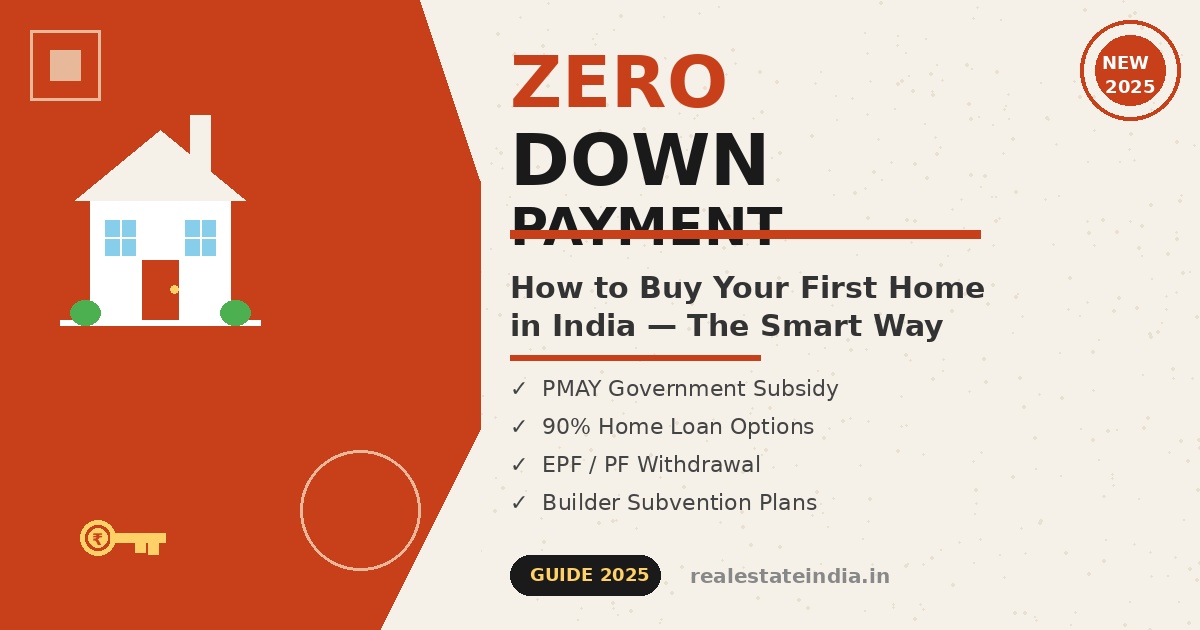
This is the single most powerful tool available to first-time homebuyers in India. Under PMAY-CLSS, eligible borrowers get an interest subsidy directly credited to their home loan account. This reduces the effective loan amount, which indirectly reduces how much you need upfront.
For middle-income group (MIG-I and MIG-II) buyers, the subsidy can go up to ₹2.35 lakh. For economically weaker sections (EWS) and low-income groups (LIG), it can go even higher — up to ₹2.67 lakh. This money gets credited directly to your loan, reducing your EMI or loan tenure.
Important: Always check the current status of PMAY on the official government portal since timelines and eligibility get updated periodically.
2. State Government Housing Schemes
Most states have their own affordable housing schemes — Maharashtra has MHADA, Delhi has DDA, Tamil Nadu has TNHB, and so on. These government bodies sell flats at controlled prices, often significantly below market rate, and sometimes with payment plans that stretch over months instead of requiring a lump sum upfront. If you qualify, this can be one of the best ways to get into homeownership without a traditional down payment.
90% Home Loans — Yes, Some Banks Offer Them
For home loans below ₹30 lakh, RBI allows banks to fund up to 90% of the property value. This means you only need to arrange 10% — a much smaller amount than most people expect. If you are buying a property worth ₹25 lakh, you would only need ₹2.5 lakh from your side, not ₹5–6 lakh.
Banks like SBI, LIC Housing Finance, and Bank of Baroda actively offer 90% LTV (Loan-to-Value) loans on smaller ticket sizes. If you are flexible about location and can look at properties in Tier-2 or Tier-3 cities, or slightly smaller flats, this option becomes very accessible.
Use Your PF (EPF) Savings to Fund the Down Payment
If you are a salaried employee contributing to the Employees’ Provident Fund (EPF), you have a legal right to withdraw your PF balance to buy a house or repay a home loan. Under EPF rules, you can withdraw up to 90% of your accumulated PF balance for purchasing property.
This is money you have already earned — it is sitting in your PF account and it qualifies for this exact purpose. Many people do not realize this is an option and let that money sit unused. Apply through your employer or the EPFO portal online. The withdrawal process takes a few weeks, so plan ahead.
Consider a Top-Up Loan or Personal Loan for the Gap
Some banks offer a combined home loan plus personal loan product. You take a home loan for the property value, and a personal loan to cover the down payment and registration charges. While the personal loan has a higher interest rate, the combined EMI can still be affordable — especially if you plan to repay the personal loan quickly.
Another approach: borrow from family. A family loan with a proper agreement and repayment plan is not uncommon in India, and banks do not penalize you for using gifted or borrowed funds as long as you disclose it properly. Some lenders even accept a ‘gift letter’ from parents or relatives in place of own-contribution proof.
Warning: Be careful not to overextend yourself. If you are already borrowing for the down payment, make sure your total EMIs (personal loan + home loan) stay within 40–45% of your monthly income.
Builder Subvention Schemes — Pay Nothing Until Possession
Several builders in India offer what is called a subvention scheme or ‘no EMI till possession’ plan. In this arrangement, you book the flat, take the loan, but the builder pays the EMIs on your behalf until the property is ready for possession. You do not pay anything out of pocket until you actually move in.
These schemes are common in cities like Pune, Hyderabad, and NCR. However, proceed with caution — always check the builder’s track record, project completion history, and RERA registration before signing anything. The risk is that if the builder delays or defaults, the loan liability still falls on you.
What About Stamp Duty and Registration Charges?
Most first-time buyers forget that stamp duty (5–7% depending on state) and registration (1%) are additional costs that banks do not cover. On a ₹50 lakh property, this can add ₹3–4 lakh.
Good news: several states offer reduced stamp duty for women buyers (Maharashtra charges just 1% for women, for example). If you register the property in your wife’s name or as a joint owner, you can save a significant amount. Some states also waive or reduce stamp duty for first-time buyers under specific income thresholds.
Also, keep in mind that while you can negotiate with the builder on price, registration charges are government-mandated and non-negotiable. Plan for them separately.
Practical Tips Before You Apply
- Check your CIBIL score first. A score above 750 gives you access to the best loan rates and maximum loan amounts. Fix any errors or overdue payments before applying.
- Compare at least 4-5 lenders. Interest rates and processing fees vary more than you think. SBI, HDFC, LIC Housing Finance, and PNB Housing often have competitive rates for first-time buyers.
- Get pre-approved. A pre-approval letter tells you exactly how much loan you qualify for and puts you in a stronger position when negotiating with builders.
- Verify RERA registration. For any under-construction property, always check that it is registered on your state’s RERA portal. This protects you legally.
- Budget for moving costs and interior. Many buyers go all-in on the property and forget they still need to furnish it. Keep a small buffer.
Final Thoughts
Buying your first home in India without a traditional down payment is not a myth. It requires planning, knowing the right schemes, and being smart about which lender and property you choose. PMAY subsidies, EPF withdrawals, 90% LTV loans, and state housing schemes together make it genuinely possible for a salaried person earning ₹40,000–₹70,000 per month to become a homeowner.
The key is to start preparing early — build your credit score, save even a small emergency fund, and research the schemes available in your city. The dream of owning a home does not have to wait for five more years of savings. With the right approach, it could be closer than you think.Disclaimer: This article is for informational purposes only. Loan eligibility, scheme availability, and government policies may change. Always consult a certified financial advisor or your bank before making any property or loan decisio


